Posts

Showing posts with the label Ancient Greek Thought

Desire in a Leaky Jar: Wants and Needs in Classical Greek Philosophy
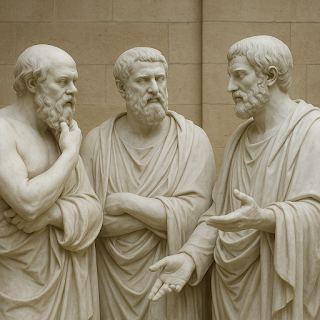
Image
AI art Introduction In today’s consumer-driven society, where the market seems to manufacture desires as rapidly as it satisfies them, the distinction between what we need and what we desire has become increasingly elusive. Yet this is not a new dilemma. Classical Greek philosophers—Socrates, Plato, and Aristotle—devoted careful thought to the nature of human wants, drawing a sharp ethical and philosophical boundary between finite needs and infinite desires . This article examines how each of these thinkers approached the problem, exploring their metaphors, arguments, and distinctions, and how their insights might still illuminate our lives today. Socrates and the Leaky Jar of Insatiable Desire In Plato’s Gorgias , Socrates delivers one of the most vivid critiques of unrestrained desire through a memorable analogy. He compares the undisciplined soul to a jar riddled with holes, forever leaking whatever is poured into it. This image is offered during a debate with Callicles, ...

The Self-Reflexive Irony of Plato’s Project

Image
  Introduction In the dialogues of Plato, philosophy is born as a critique of poetic speech, yet it emerges through literary form. This tension lies at the heart of Plato’s project: Socrates, Plato’s mouthpiece, denounces the poets as ignorant imitators, while himself speaking in riddles, myths, and images. Plato's writing stages a curious paradox: the philosopher critiques poetic inspiration while employing its tools. This article explores that irony as a prelude to broader reflections on truth, language, and authorship in thinkers like Nietzsche, Derrida, Lacan—and even large language models. Socrates on Poets in the Republic In Republic Book X, Socrates famously calls for the exclusion of poets from the ideal city. His objection is not merely moral, but ontological. Poetry, as mimēsis—imitation—is a copy of a copy, thrice removed from the truth. A painter, he argues, only reproduces the appearance of a bed, not its essence. Similarly, Homer may depict heroes and battles b...