Posts

Showing posts with the label Ethics

Desire in a Leaky Jar: Wants and Needs in Classical Greek Philosophy
Image
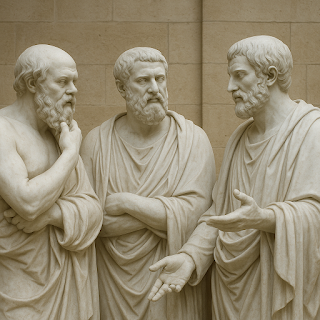
AI art Introduction In today’s consumer-driven society, where the market seems to manufacture desires as rapidly as it satisfies them, the distinction between what we need and what we desire has become increasingly elusive. Yet this is not a new dilemma. Classical Greek philosophers—Socrates, Plato, and Aristotle—devoted careful thought to the nature of human wants, drawing a sharp ethical and philosophical boundary between finite needs and infinite desires . This article examines how each of these thinkers approached the problem, exploring their metaphors, arguments, and distinctions, and how their insights might still illuminate our lives today. Socrates and the Leaky Jar of Insatiable Desire In Plato’s Gorgias , Socrates delivers one of the most vivid critiques of unrestrained desire through a memorable analogy. He compares the undisciplined soul to a jar riddled with holes, forever leaking whatever is poured into it. This image is offered during a debate with Callicles, ...

Beyond Good and Evil: Nietzsche and the Deconstruction of Moral Values

Image
Introduction In the late 19th century, Friedrich Nietzsche experienced a period of personal isolation and commercial failures that profoundly influenced his intellectual production. Amid this adversity emerged one of his most emblematic works, Beyond Good and Evil , a book that challenges the foundations of Western philosophy and questions traditional ethical values. In this work, Nietzsche argues that the moral dichotomies and value antitheses that have dominated philosophical thought are not absolute but conventional constructions that must be overcome. This argument paved the way for new ways of thinking, later influencing movements like existentialism, poststructuralism and Jacques Derrida's deconstruction, among others. The radical and provocative nature of Beyond Good and Evil led to its being perceived as a “dangerous” work—a label that does not censor the philosopher but underscores his capacity to revolutionize traditional ideas. The depth and boldness of the book ...

Between Construct and Reality: A Balanced View of Moral Frameworks

Image
Objective To analyze Nietzsche’s critique of morality as a social construct, emphasizing its symbolic nature and relational meaning, while acknowledging its practical relevance within communities. Drawing on Peirce’s semiotic framework, the article will demonstrate how moral signs interact with reality through icons and indices. It will also examine the role of religious codes, their divine framing, and the duality of benefits and restrictions they impose on individuals within a community. 1. Introduction Friedrich Nietzsche’s Twilight of the Idols presents a provocative critique of moral systems, arguing that they are symbolic constructs imposed to regulate human behavior. He contends that ethics is often underpinned by a false claim of divine origin, strategically employed to ensure compliance. By framing ethical rules as sacred mandates, authorities mask their human invention, transforming pragmatic societal guidelines into seemingly eternal laws. However, Charles Sand...

Decoding Morality: A Semiotic Exploration of Nietzsche’s Twilight of the Idols

Image
Objective This article delves into Friedrich Nietzsche’s critique of ethical constructs as shaped by cultural, historical, and psychological conditions, interpreted through the lens of semiotics. It draws on Ferdinand de Saussure’s theory of signs and Roland Barthes’s concept of second-order systems to examine morality as a symbolic framework dependent on relational meaning rather than intrinsic truths. By exploring Nietzsche’s depiction of ethical codes as a “sign language” and a “symptomatology,” the analysis highlights how semiotic theory deepens our understanding of his critique of moral absolutism. Furthermore, it underscores the broader applicability of semiotics in dissecting the hidden structures that underlie not only moral systems but also other cultural phenomena. 1. Introduction In Twilight of the Idols , Friedrich Nietzsche critiques traditional moral codes, describing them as symbolic constructs rooted in cultural and psychological contexts rather than objective ...